This is an excerpt from my book-in-progress, You Would Choose Now: Measuring America’s Progress Toward Fairness and Tolerance. It’s a data-driven exploration of progress (or not) in public opinion and civil rights. The completed chapters are available as an Early Access edition on LeanPub.
This excerpt, from Chapter 2, is about legal protection from workplace discrimination.
From beliefs to policies
To track changes in public opinion, we’ll look at responses to a survey question in the American National Election Studies (ANES), which asks:
Do you favor or oppose laws to protect homosexuals (gays and lesbians) against job discrimination?
The following figure shows the estimated percentage who favor such laws.
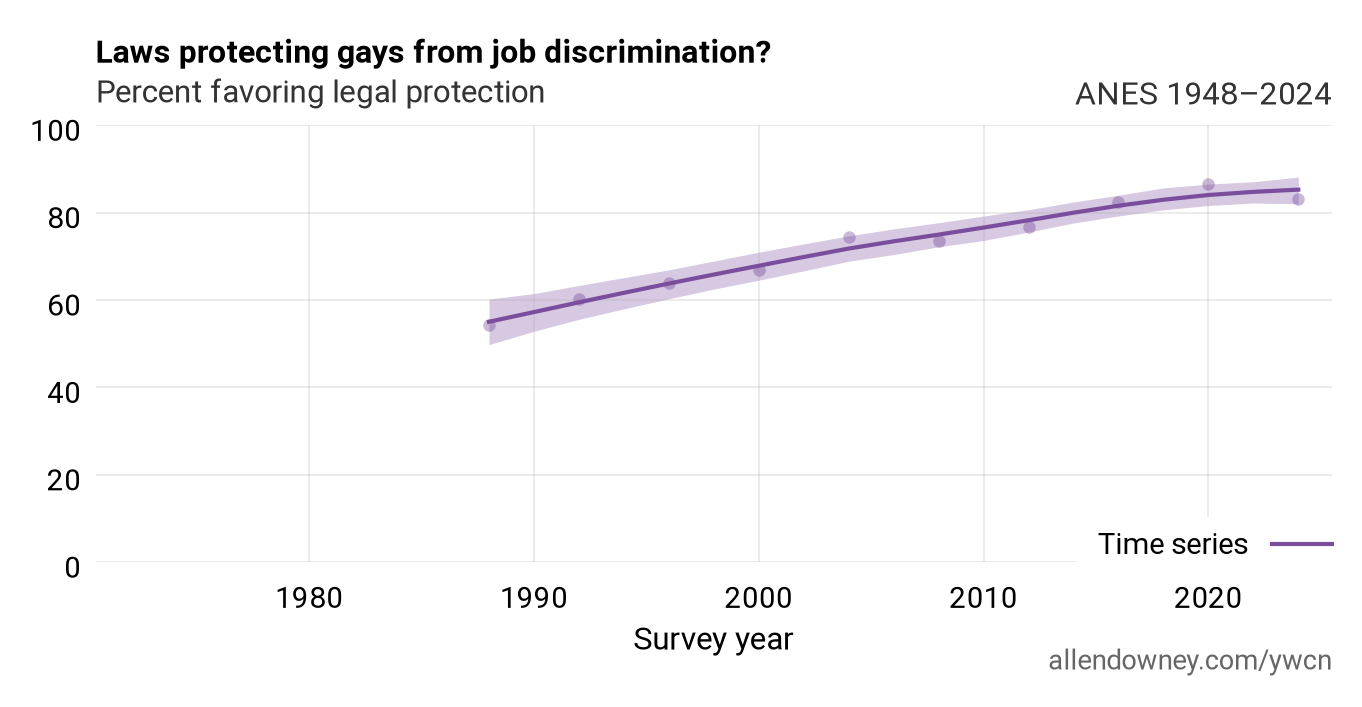
In 1988, when the ANES first asked about anti-discrimination laws, support was already above 50% — about 55% in the model estimate. But at that time only one state — Wisconsin — prohibited job discrimination based on sexual orientation. In most of the country, employers could legally refuse to hire or promote gay people, and they could fire someone because they were gay.
In 1989, Massachusetts enacted similar protections. And between 1990 and 2020, seventeen more states and the District of Columbia passed similar laws.
But even in 2020, when support for legal protection was above 80%, discrimination was still legal in 31 states. That year, the Supreme Court’s decision in Bostock v. Clayton County finally extended protections nationwide.
The Court consolidated three cases: Gerald Bostock, a child welfare services coordinator in Clayton County, Georgia, alleged that he was fired after joining a gay recreational softball league; Donald Zarda, a skydiving instructor, alleged that he was fired after telling a customer he was gay; and Aimee Stephens, a funeral director, alleged that she was fired after informing her employer that she intended to live and work as a woman.
In a 6-3 decision, the Court held that “An employer who fires an individual merely for being gay or transgender defies the law.” Notably, the Court did not find that it was illegal to discriminate on the basis of sexual orientation specifically, but rather that, “it is impossible to discriminate against a person for being homosexual or transgender without discriminating against that individual based on sex.”
In the majority opinion, Justice Neil Gorsuch, who was nominated in 2017 by Donald Trump, explains:
Consider, for example, an employer with two employees, both of whom are attracted to men. The two individuals are, to the employer’s mind, materially identical in all respects, except that one is a man and the other a woman. If the employer fires the male employee for no reason other than the fact he is attracted to men, the employer discriminates against him for traits or actions it tolerates in his female colleague.
The opinion concludes that workplace discrimination based on sexual orientation is a kind of discrimination based on sex, which was illegal under the Civil Rights Act of 1964. By that logic, legal protections for homosexuals should have been in effect for more than fifty years!
This excerpt is from You Would Choose Now, a work in progress I plan to publish in 2027. What follows is additional material that’s not in the book.
Changing minds and generational replacement
When public opinion changes, there are two kinds of explanation to consider:
Changing minds: People adopt different views over the course of their lives, possibly in response to events.
Generational replacement: As older people die or age out of the survey, they are replaced by young adults with different views.
With a repeated survey like the ANES, we can decompose the change into a period component that represents changes over time and a cohort component that represents changes between generations. Here’s the estimated cohort component — that is, the part of the change the statistical model attributes to generational replacement.
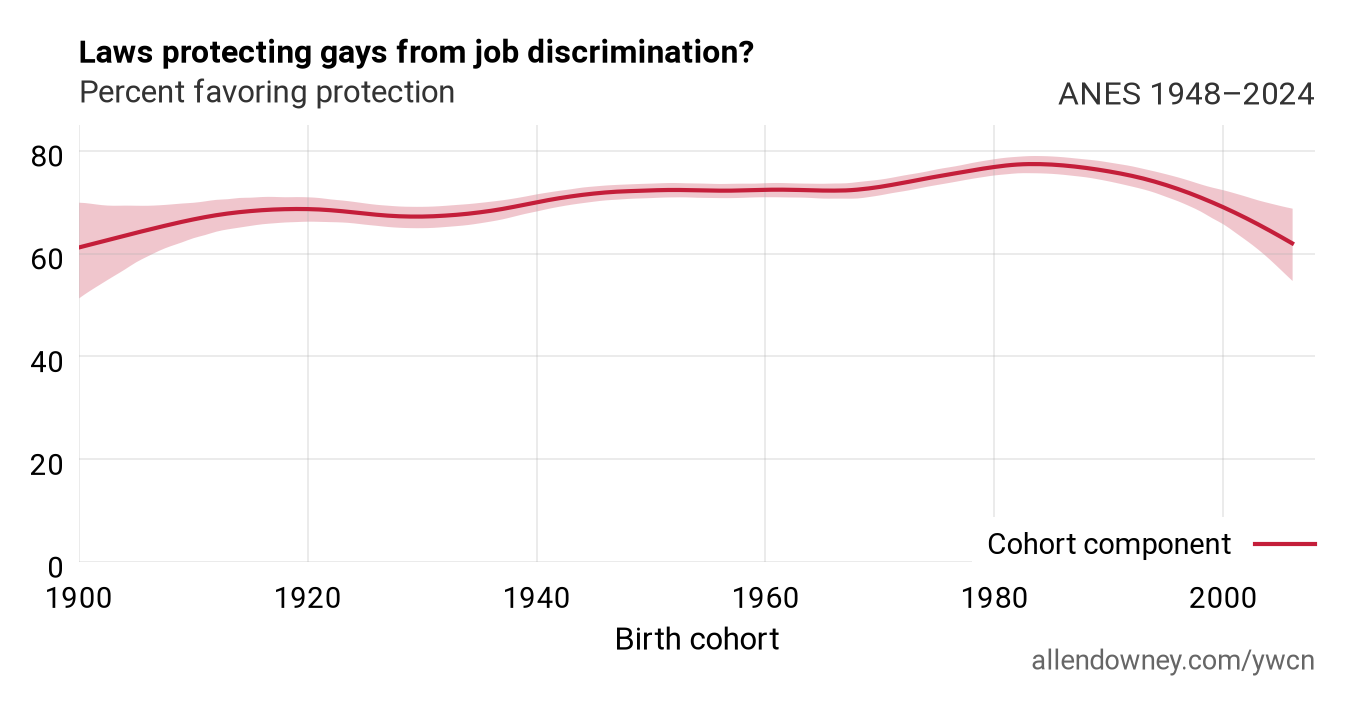
Support for anti-discrimination laws was relatively low among people born in 1900, gradually increased through the cohorts born in the early 1980s, and has softened slightly among the youngest generations in the survey. That dip is small — when we get more data, we will see whether it continues.
The following figure shows the period component that remains after we control for generational replacement, along with the original time series — the small gap between them is the contribution of generational replacement.
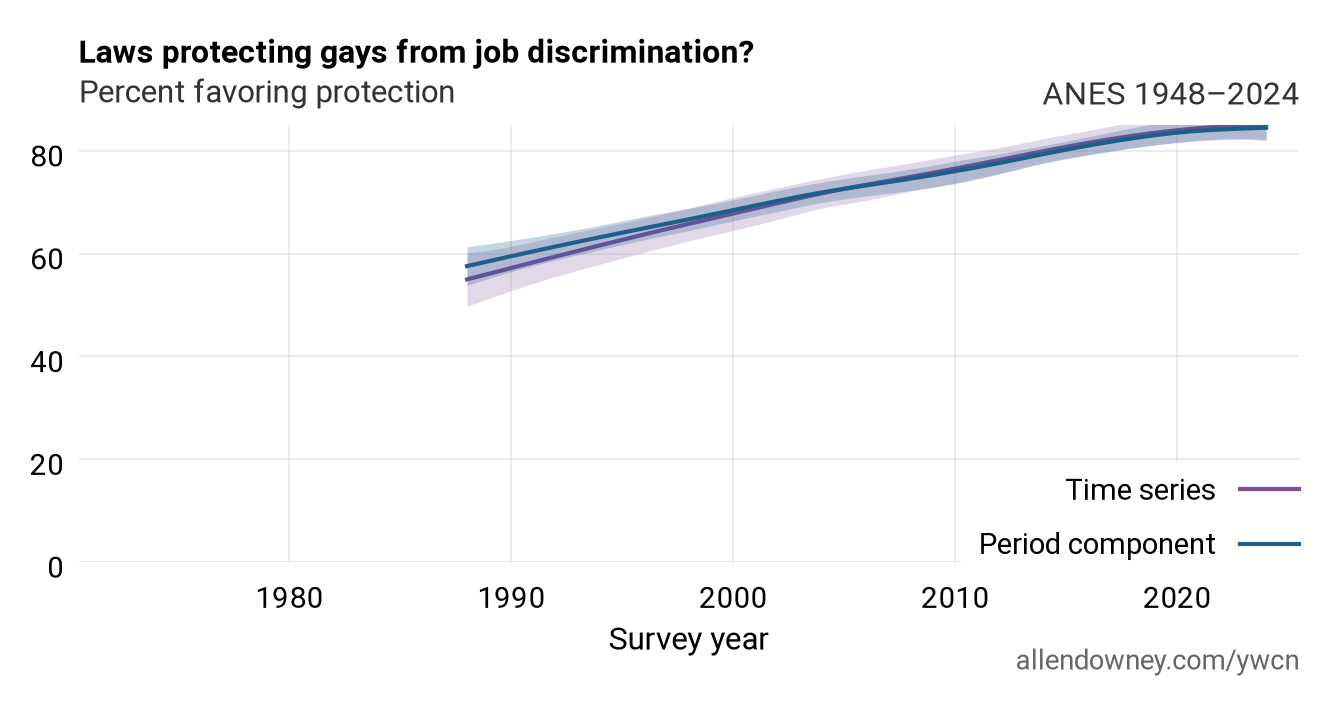
Looking at the net change from 1988 to 2024, about 9% can be attributed to generational replacement and about 91% to changing minds. Statistically, we could not say with confidence that generational replacement made any contribution at all.