This is an excerpt from my book-in-progress, You Would Choose Now: Measuring America’s Progress Toward Fairness and Tolerance. It’s a data-driven exploration of progress (or not) in public opinion and civil rights. The completed chapters are available as an Early Access edition on LeanPub.
This excerpt, from Chapter 2, is about same-sex marriage.
Same-sex marriage
Do you agree or disagree with the following statement: Homosexual couples have or should have the right to marry one another.
The following figure shows the percentage who agree or strongly agree.
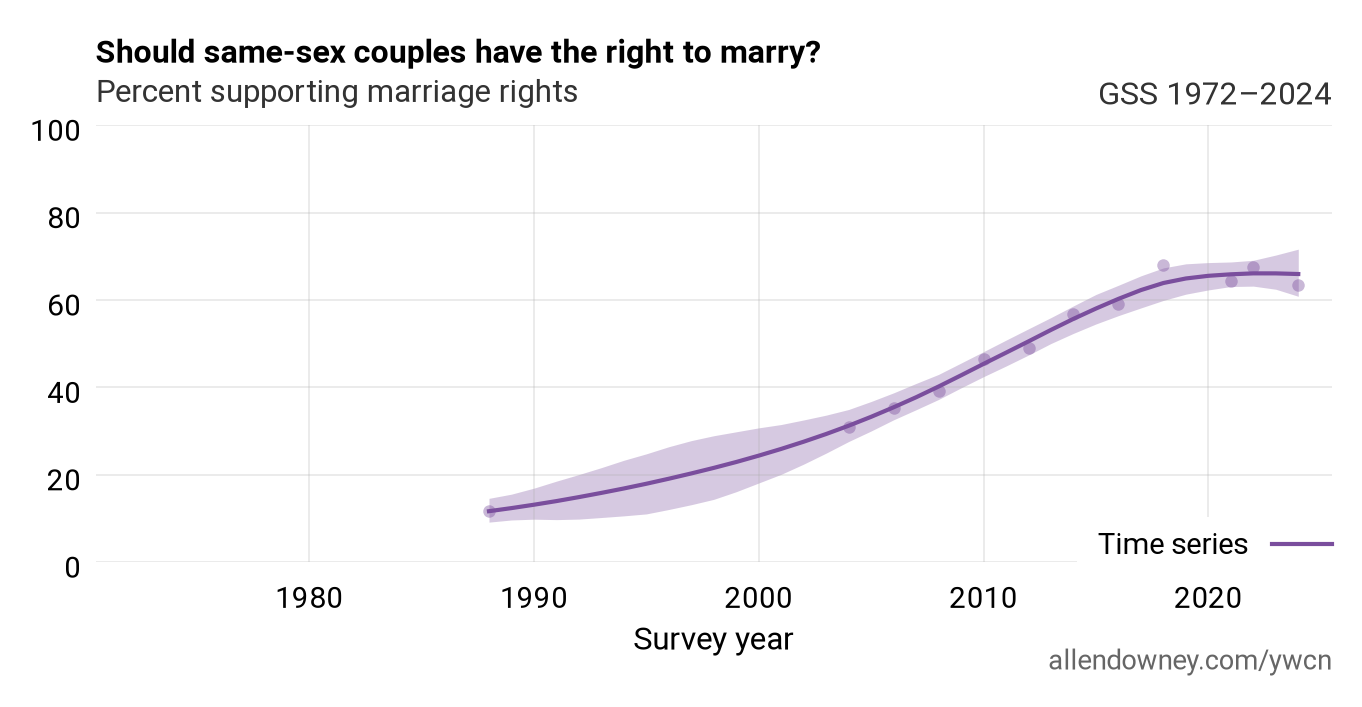
When the General Social Survey (GSS) first asked about gay marriage in 1988, only about 12% of Americans supported it. Now about 66% do — an increase of 54 percentage points in 46 years. Let’s see how the law responded to these changes in opinion.
In 1996, the Defense of Marriage Act (DOMA) was passed by Congress and signed by President Bill Clinton. For purposes of federal law, it defined “marriage” to mean “only a legal union between one man and one woman” and it defined “spouse” to refer “only to a person of the opposite sex”. It also declared that states need not recognize a same-sex marriage performed in another state.
That last provision was preemptive because at the time no states had legalized gay marriage — Massachusetts became the first eight years later, in 2004. At that point, support for gay marriage had risen to 45% nationally.
In 2007, it was above 50%, and in 2011, it was closer to 60%. At that point, the Senate held hearings on a bill, the Respect for Marriage Act, which would repeal the Defense of Marriage Act. If the names of the bills are confusing, just remember that “defending marriage” means opposition to gay marriage, and “respect for marriage” is the opposite.
In an unusually entertaining hearing about the Respect for Marriage Act, Senator Al Franken questioned a representative of Focus on the Family, a conservative group that argued that children do best when raised by a mother and a father.
Mr. Minnery, on page eight of your written testimony [...] You cite a Department of Health and Human Services study [...] to support this conclusion. I [pause] checked the study out... [Laughter]
To understand why the audience laughed at that point, you should know that before he was a senator, Al Franken was a comedian who starred on Saturday Night Live. As a comedian, he was famous for a deadpan delivery; as a politician, he used that delivery with withering effectiveness. As Mr. Minnery takes a visibly nervous sip of water, Franken resumes:
... and [the study] actually doesn’t say what you said it says. It says that nuclear families, not opposite-sex married families, are associated with those positive outcomes. Isn’t it true, Mr. Minnery, that a married same-sex couple that has had or adopted kids would fall under the definition of a nuclear family in the study that you cite?
Minnery replies:
I would think that the study, when it cites nuclear families, would mean a family headed by husband and wife.
With the demeanor of a teacher talking to a slow child, Franken explains.
It doesn’t. [More Laughter]
Here you might have to watch the video to appreciate the humor. Franken concludes:
The study defines a nuclear family as one or more children living with two parents who are married to one another and are each biological or adoptive parents to all the children in the family. And I frankly don’t really know how we can trust the rest of your testimony if you are reading studies these ways.
The bill passed the Judiciary Committee, but despite Franken’s performance, Democrats did not have the votes to overcome a filibuster on the Senate floor, so the bill never became law. Instead, the issue was decided by the courts.
In 2013, in United States v. Windsor, the Supreme Court struck down a central part of DOMA. The case involved Edith Windsor and Thea Spyer, a same-sex couple whose marriage in Canada had been recognized by the state of New York, where they lived. When Spyer died, Windsor inherited her estate, but under DOMA, the IRS did not consider Windsor a “spouse”, so she had to pay estate taxes that an opposite-sex spouse would not have owed.
In a 5-4 decision, the Court held that the relevant part of DOMA was unconstitutional “as a deprivation of the liberty of the person protected by the Fifth Amendment”.
The Fifth Amendment might be most famous for protecting a criminal defendant from being “compelled in any criminal case to be a witness against himself” — hence “taking the Fifth”. But it also contains this prohibition, which is more relevant:
No person shall [...] be deprived of life, liberty, or property, without due process of law.
Even with that, it might not be clear how we get from the Fifth Amendment to the Windsor decision. If Congress passes a discriminatory federal law, the text of the Fifth Amendment doesn’t obviously forbid it.
For that, we need another piece, the Fourteenth Amendment, which includes this requirement:
nor shall any State deprive any person of life, liberty, or property, without due process of law; nor deny to any person within its jurisdiction the equal protection of the laws.
The key phrase here is “equal protection of the laws”, which more clearly applies to Windsor — but the Fourteenth Amendment only restricts the states, not the federal government.
For that, we need one final piece: Bolling v. Sharpe, the 1954 companion case to Brown v. Board of Education. The Brown decision held that state-sponsored school segregation violated the Fourteenth Amendment. But the segregated schools in Bolling were in Washington, D.C., where the schools were controlled by the federal government — so the Fourteenth did not apply.
Rather than allow the federal government to operate segregated schools, while forbidding the states from doing the same, the Court held that the Fifth Amendment’s Due Process Clause prohibits the federal government from engaging in unjustified discrimination. In effect, it took equal protection from the Fourteenth Amendment and applied it to the federal government through the Fifth.
If all of that sounds like a shaky foundation to rest civil rights on, you are getting my point.
After Windsor, the federal government recognized same-sex marriages that were valid under state law, but states were free to decide whether to issue marriage licenses, and 13 still prohibited it. Then in 2015, in Obergefell v. Hodges, the Supreme Court decided that states were required to license same-sex marriages and to recognize marriages from other states. The lead plaintiff, James Obergefell, married John Arthur in Maryland, where same-sex marriage was legal, but they lived in Ohio, where it was not. When Arthur died, Ohio did not recognize Obergefell as his surviving spouse.
In the majority opinion, Justice Kennedy invoked the liberty protected by the Due Process Clause and the equality protected by the Equal Protection Clause — both directly from the Fourteenth Amendment, with no detour through the Fifth.
Obergefell might be on more solid ground than Windsor, but even so, in 2022 Congress took up a new Respect for Marriage Act, which repealed the remaining provisions of DOMA — it required federal recognition of same-sex marriages, and required states to recognize marriages performed in other states. It passed with substantial bipartisan support and was signed by President Joe Biden.
This excerpt is from You Would Choose Now, a work in progress I plan to publish in 2027. What follows is additional material that’s not in the book.
Changing minds and generational replacement
When public opinion changes, there are two kinds of explanation to consider:
Changing minds: People adopt different views over the course of their lives, possibly in response to events.
Generational replacement: As older people die or age out of the survey, they are replaced by young adults with different views.
With a repeated survey like the GSS, we can decompose the change into a period component that represents changes over time and a cohort component that represents changes between generations. Here’s the estimated cohort component — that is, the part of the change the statistical model attributes to generational differences.
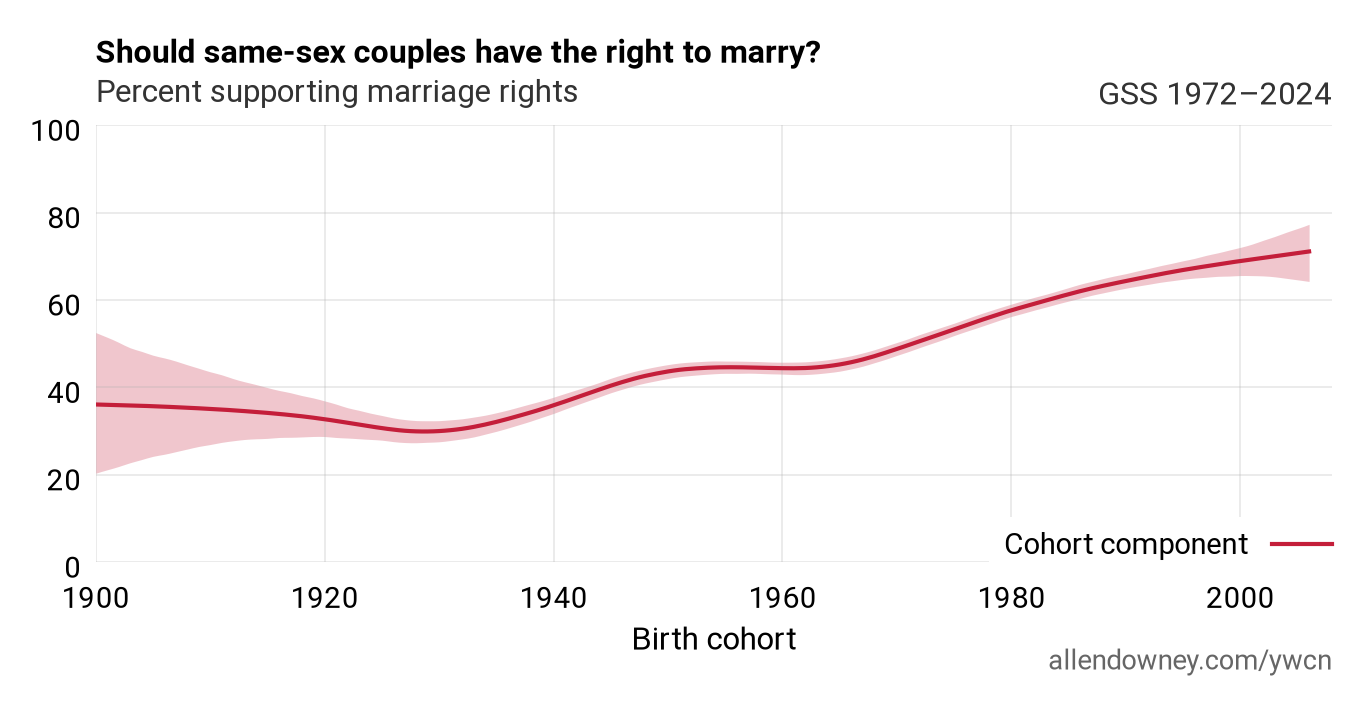
Among cohorts born after 1930, each successive generation is more likely to support gay marriage than the previous one.
The following figure shows the period component that remains after we control for differences between generations, along with the original time series — the gap between them is the contribution of generational replacement.
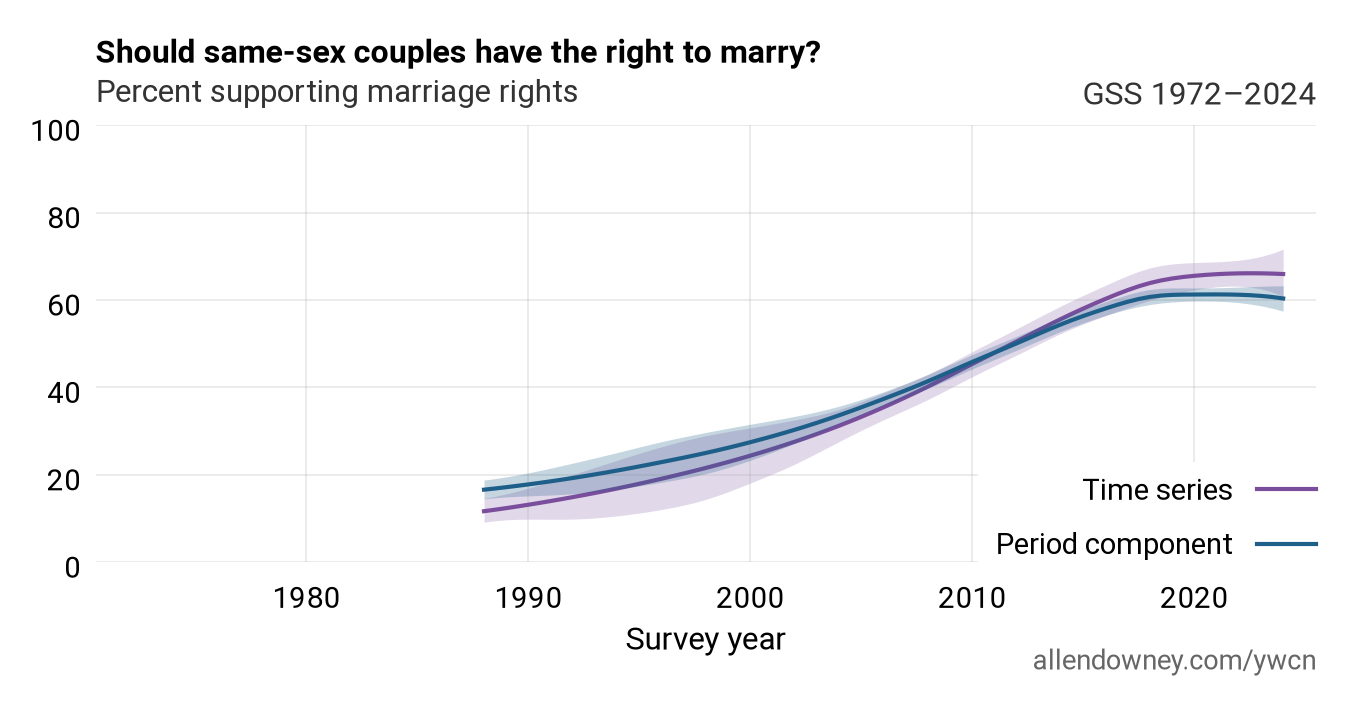
Looking at the net change from 1988 to 2024, about 20% can be attributed to generational replacement and about 80% to changing minds.