This is an excerpt from my book-in-progress, You Would Choose Now: Measuring America’s Progress Toward Fairness and Tolerance. It’s a data-driven exploration of progress (or not) in public opinion and civil rights. The completed chapters are available as an Early Access edition on LeanPub.
This excerpt, from Chapter 2, is about gays and lesbians in the military.
One of the recurring questions in this book is how changes in public opinion relate to public policy. Do attitudes change first, creating pressure for policy change? If so, how? And does it ever go the other way?
As an example, we’ll consider the history of gays and lesbians in the U.S. military. In 1992, a majority of Americans thought homosexuals should be allowed to serve, but the military could still reject applicants or discharge service members for being gay. To see how that changed, we’ll start with the trajectory of public opinion; then we’ll look at the policy, including the regrettable compromise known as “Don’t Ask, Don’t Tell”.
To track public opinion, we’ll use responses to this survey question in the American National Election Studies (ANES):
Do you think homosexuals should be allowed to serve in the United States Armed Forces or don’t you think so?
The following figure shows the estimated percentage who say they should be allowed to serve.
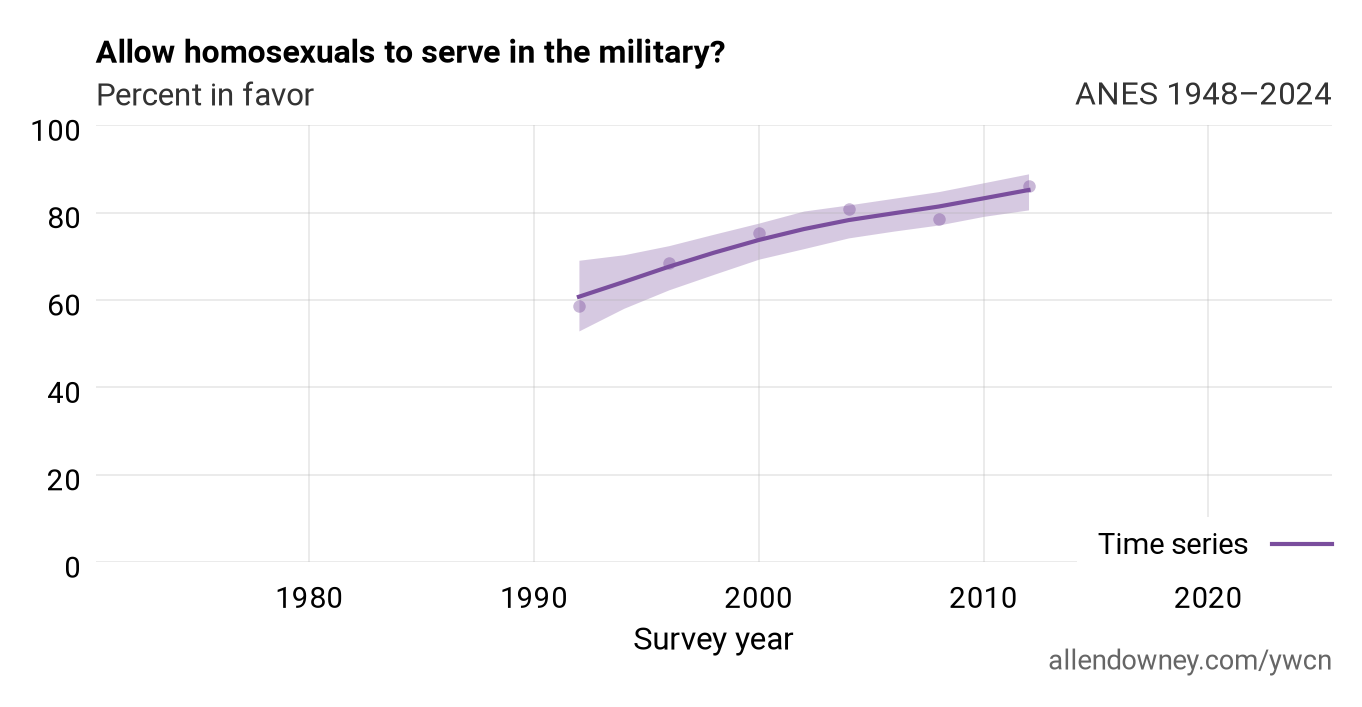
In 1992, when the ANES first asked this question, support for gays in the military was about 61%. But at that time, anyone applying to join the armed forces was asked directly about their sexual orientation during the enlistment process. If an applicant admitted being gay, lesbian, or bisexual — or stated that they had engaged in homosexual acts — they were generally rejected.
Also at that time, military personnel could be investigated if they were suspected of being homosexual. If they admitted that they were gay, or the investigation concluded that they were, they would usually be discharged from service. In civilian vocabulary, they would be fired from their jobs and evicted from their housing. To make matters worse, most of them received less-than-honorable discharges, which means that they were not eligible for some veterans’ benefits.
During the 1992 presidential campaign, Bill Clinton promised to allow gay men and lesbians to serve openly. But once in office, he faced strong opposition from military leadership, including Colin Powell, who was chairman of the Joint Chiefs of Staff, and some members of Congress, notably Senator Sam Nunn, who was chairman of the Armed Services Committee.
The Clinton administration negotiated a compromise that became known as “Don’t Ask, Don’t Tell” or DADT, enacted in 1993. Under this policy, recruiters would not ask applicants if they were gay, service members could not disclose that they were gay, and commanders were not supposed to initiate investigations without credible evidence. But service members could still be discharged for stating they were gay or engaging in homosexual conduct.
In 2008, during his presidential campaign, Barack Obama pledged to repeal DADT. By then, popular support for gays in the military was above 80%.
In February 2010, Admiral Mike Mullen, then chairman of the Joint Chiefs of Staff, testified before Congress:
No matter how I look at this issue, I cannot escape being troubled by the fact that we have in place a policy which forces young men and women to lie about who they are in order to defend their fellow citizens.
He concluded, “It is my personal belief that allowing gays and lesbians to serve openly would be the right thing to do.”
Coming from the country’s highest-ranking military officer, this testimony was influential. Congress repealed the policy in 2010, allowing open military service to begin in 2011. By then, public support was almost 85% (the ANES has not included the question since 2012).
A 2018 report estimates that 5.8% of active-duty service members identified as gay, lesbian, or bisexual, and 0.6% as transgender. If the percentages are about the same today, out of 1.3 million service members, that’s 70,000-90,000 LGBTQ people defending their fellow citizens.
This excerpt is from You Would Choose Now, a work in progress I plan to publish in 2027. What follows is additional material that’s not in the book.
Changing minds and generational replacement
When public opinion changes, there are two kinds of explanation to consider:
Changing minds: People adopt different views over the course of their lives, possibly in response to events.
Generational replacement: As older people die or age out of the survey, they are replaced by young adults with different views.
With a repeated survey like the ANES, we can decompose the change into a period component that represents changes over time and a cohort component that represents changes between generations. Here’s the estimated cohort component — that is, the part of the change the statistical model attributes to generational replacement.
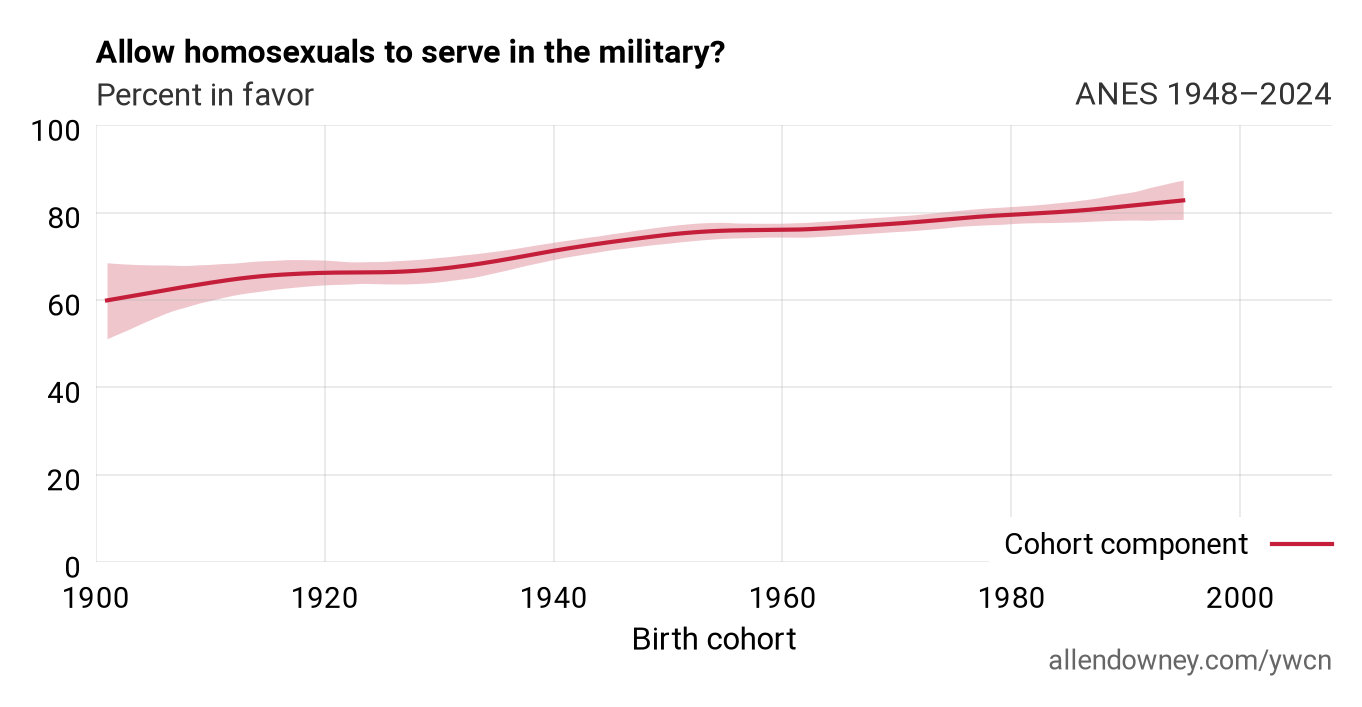
The cohort component has increased consistently — each generation is more likely than the previous to support gays in the military.
The following figure shows the period component that remains after we control for generational replacement, along with the original time series — the small gap between them is the contribution of generational replacement.
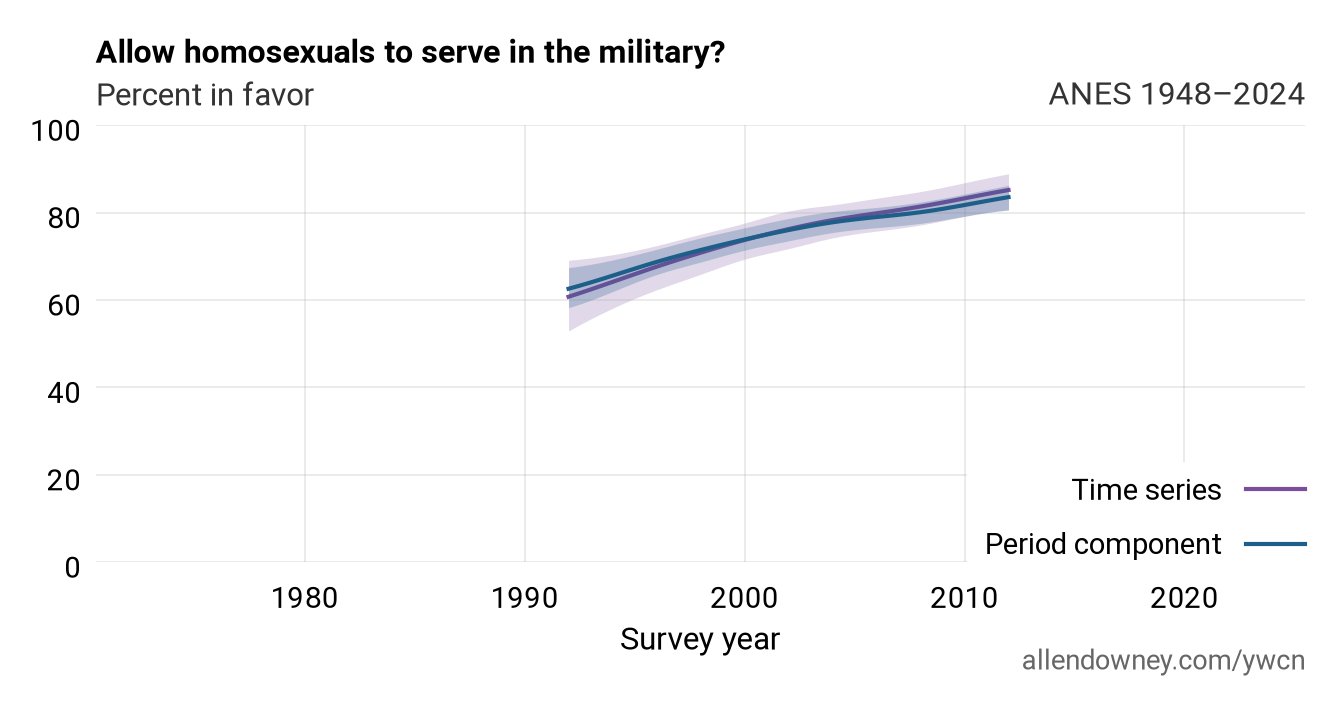
Looking at the net change from 1992 to 2012, about 15% can be attributed to generational replacement and about 85% to changing minds. But statistically, we couldn’t say with confidence that generational replacement made any contribution.