This is an excerpt from my book-in-progress, You Would Choose Now: Measuring America’s Progress Toward Fairness and Tolerance. It’s a data-driven exploration of progress (or not) in public opinion and civil rights. The completed chapters are available as an Early Access edition on LeanPub.
This excerpt, from Chapter 2, is about adoption by gay and lesbian couples.
Changing minds about adoption
“Do you think gay or lesbian couples, in other words, homosexual couples, should be legally permitted to adopt children?”
The American National Election Studies (ANES) has been asking Americans that question (and overexplaining it) since 1992. The following figure shows the percentage who said yes.
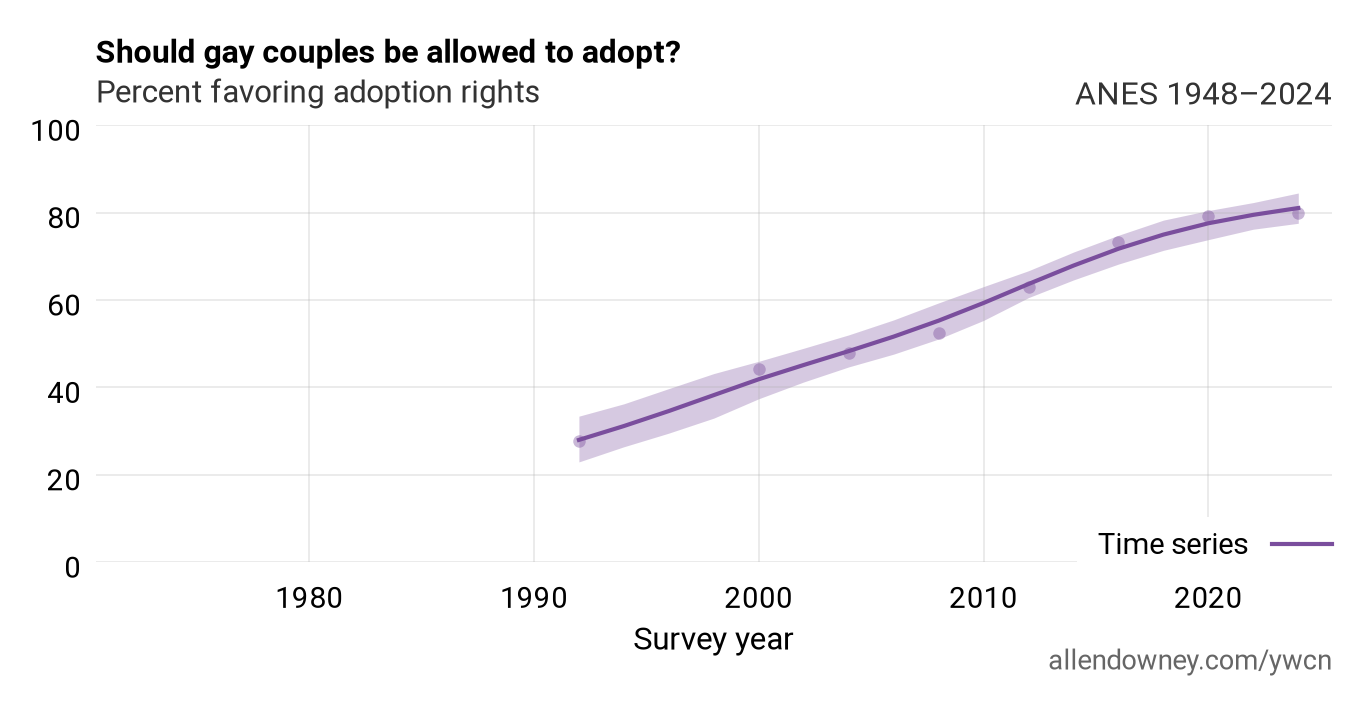
In 1992, only 28% of Americans thought gay couples should be allowed to adopt. By 2008, support was above 50%. And in 2024, it was about 81% — an increase of more than fifty percentage points in thirty-two years.
During those years, state laws were all over the map.
In 1993, Vermont and Massachusetts were the first states to recognize adoption rights for same-sex couples — both through state supreme court decisions. In the Massachusetts case, called Adoption of Tammy, the decision was based on the absence of prohibition: state laws did not prohibit unmarried couples from filing jointly and said nothing about gender or sexual orientation. So that’s another example, like Bostock on employment discrimination, where civil rights were extended based on existing law rather than constitutional protection.
New York followed in 1995, New Jersey in 1996, then California, Connecticut, Illinois, Maryland, New Mexico, Rhode Island, Washington, and several other states between 2000 and 2005. Over that period, only a few states had explicit bans, but many had policies that prevented gay people, same-sex couples, or unmarried couples from adopting.
In 2010, Florida was the last state where gay people could not adopt, based on a statute saying, “No person eligible to adopt under this statute may adopt if that person is a homosexual.”
That statute was enacted in 1977 during the “Save Our Children” campaign led by Anita Bryant. It was overturned by the Florida Third District Court of Appeal in a case called In re Gill, after Frank Martin Gill, who applied to adopt two children he was already raising as a foster parent.
The court found that the ban violated the equal protection guarantees of the Florida Constitution. Adding salt to the ruling, the court found that there was no “rational basis” for the ban, which means that the statute failed to meet what is considered the lowest legal standard. The Florida Attorney General chose not to appeal the decision to the Supreme Court of Florida, so it became final. And Gill’s adoption of the two boys became final in January 2011.
At that point, the matter was all but settled at the state level, but there were no federal protections until a series of Supreme Court decisions: Obergefell v. Hodges in 2015, which established nationwide marriage equality; V.L. v. E.L. in 2016, which requires same-sex adoptions recognized in one state to be recognized in every state; and Pavan v. Smith in 2017, which requires states to extend the same parental recognition to married same-sex couples that they provide to married opposite-sex couples.
It did not take long for federal law to catch up with public opinion. In 2008, a majority of Americans thought gay couples should be allowed to adopt. Nine years later, the law was on their side.
After that, it is plausible that the law changed public opinion. As more gay couples adopted, more people became aware of children with two mommies or two daddies. In 2012, about 48% agreed that “same sex female couple can bring up a child as well as a male-female couple”, and 44% thought a male couple could, too. In 2022, those percentages were up to 62% and 59%. And now that those children and their friends have grown up, they are even more likely to agree — among people born in the 2000s, more than 70% do.
This excerpt is from You Would Choose Now, a work in progress I plan to publish in 2027. What follows is additional material that’s not in the book.
Changing minds and generational replacement
When public opinion changes, there are two kinds of explanation to consider:
Changing minds: People adopt different views over the course of their lives, possibly in response to events.
Generational replacement: As older people die or age out of the survey, they are replaced by young adults with different views.
With a repeated survey like the ANES, we can decompose the change into a period component that represents changes over time and a cohort component that represents changes between generations. Here’s the estimated cohort component — that is, the part of the change the statistical model attributes to generational differences.
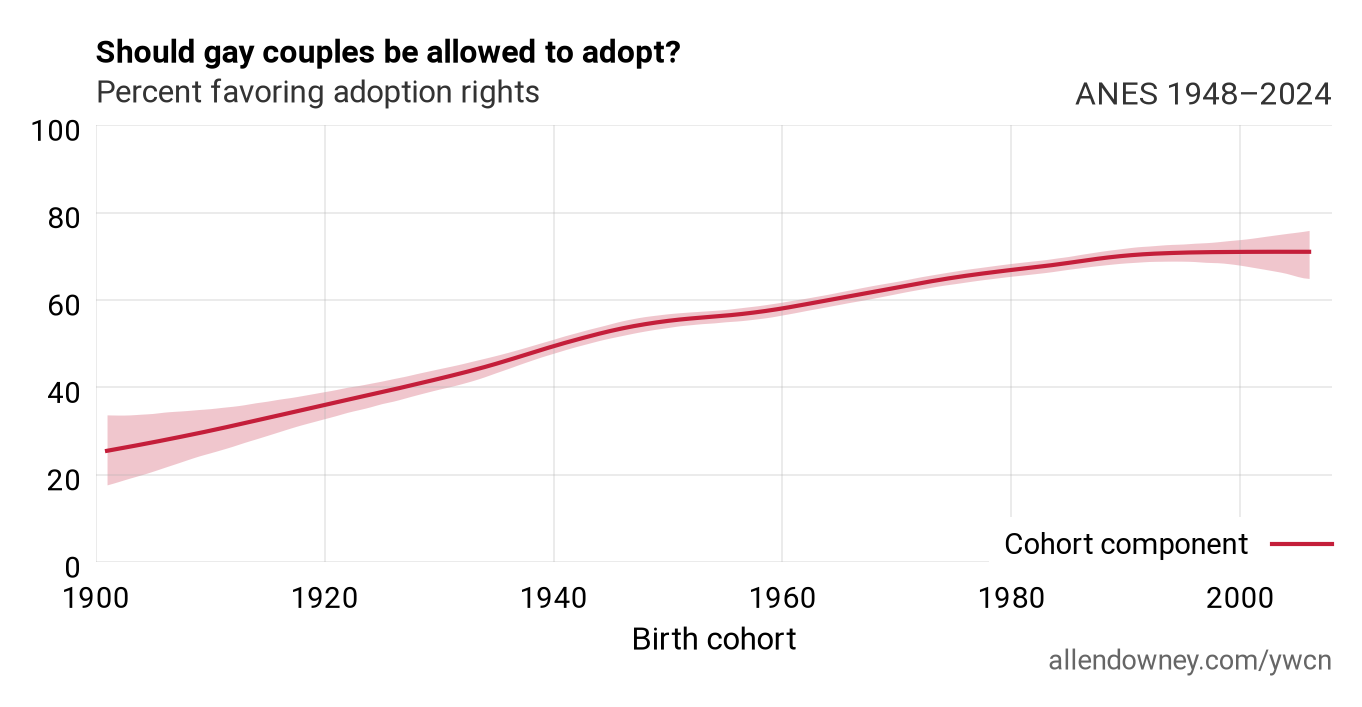
Starting with people born in 1901, each generation is more supportive of adoption rights than the previous one, up through people born in 2006.
The following figure shows the period component that remains after we control for differences between generations, along with the original time series — the gap between them is the contribution of generational replacement.
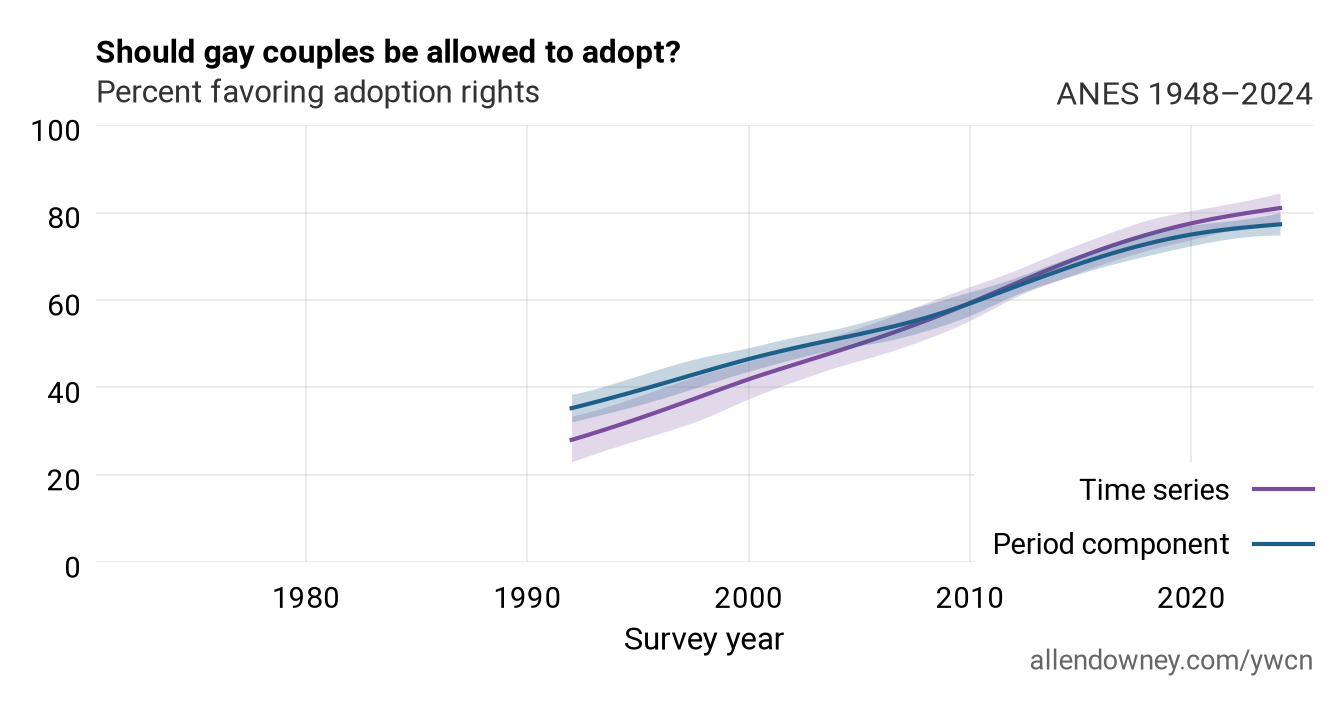
Looking at the net change from 1992 to 2024, about 20% can be attributed to generational replacement and 80% to changing minds.